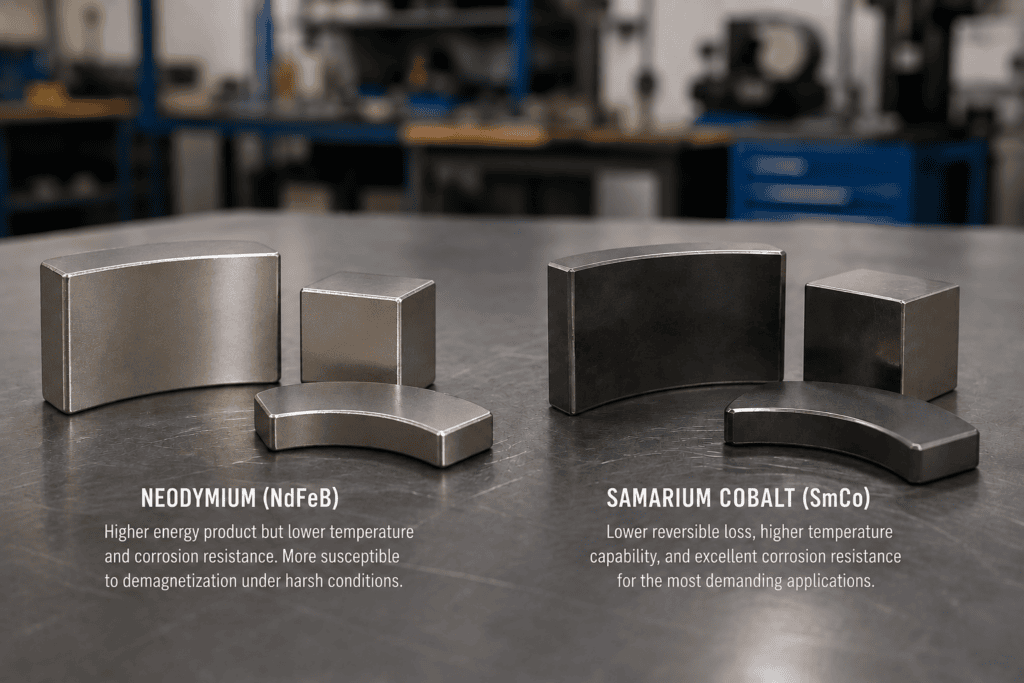
A design engineer sizes a rotor for a pump motor, selects an N42 neodymium arc segment, and validates the assembly on the bench at room temperature. Field strength looks good. Six months later, units returning from the field measure low on torque, and the magnets themselves test below their original flux. Nothing broke. The material simply operated outside its useful temperature range.
This is one of the most common reasons a project ends up revisiting the samarium cobalt vs neodymium decision, usually later than it should. Both materials are rare earth permanent magnets, and neodymium iron boron does deliver the higher energy product. But energy product alone is a poor selection criterion. What determines whether a magnet holds its performance is how the material behaves under the temperature, load, and environmental conditions of the actual application.
Below is a practical framework for making that call.
Start With the Operating Environment, Not the Energy Product
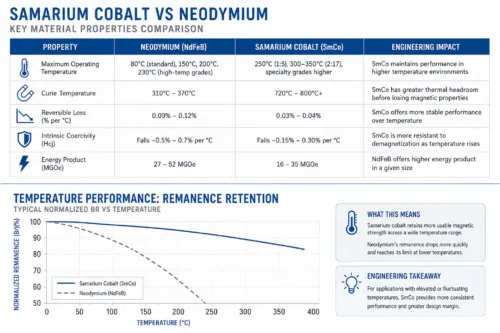
Neodymium magnets offer roughly 27 to 52 MGOe in common commercial grades, while samarium cobalt typically falls between 16 and 35 MGOe. Our chart of material properties lists these values side by side. On a spec sheet, neodymium wins on paper nearly every time. In service, the useful comparison is different: how much field remains at the operating point, after temperature rise, after years of thermal cycling, and after exposure to whatever the environment contains.
That shifts the question. Instead of asking which material is stronger, ask what the magnet has to survive. Three environmental factors drive most samarium cobalt vs neodymium decisions in industrial equipment:
- Sustained operating temperature, including local hot spots rather than ambient averages
- Demagnetizing influences, such as opposing fields from windings, tight air gaps, or thin magnet geometries
- Chemical and moisture exposure, including washdown, humidity, process fluids, and vacuum service
If none of these are demanding, neodymium is usually the efficient choice. When one or more becomes a design constraint, samarium cobalt often earns its higher material cost.
Temperature Capability: Where Neodymium Runs Short of Margin
Temperature is the clearest dividing line. Standard neodymium grades carry a maximum recommended operating temperature near 80°C. High coercivity grades extend that range, reaching roughly 150°C, 200°C, and in some 230°C grades, at the cost of energy product. Samarium cobalt, by comparison, works reliably at 250°C in 1:5 formulations and commonly 300°C to 350°C in 2:17 formulations, with specialty grades rated higher.
The Curie temperature tells a similar story. Neodymium iron boron typically sits in the 310°C to 370°C range, while samarium cobalt runs from roughly 720°C to above 800°C depending on composition. A higher Curie temperature means the operating range stays well below the point where magnetic order breaks down, which leaves more thermal headroom for excursions the design did not anticipate.
Reversible loss matters just as much as the maximum rating. Neodymium loses roughly 0.09% to 0.12% of remanence per degree Celsius, while samarium cobalt loses closer to 0.03% to 0.04%. Over a 150°C rise, that difference is substantial. For motors, generators, magnetic couplings, and sensing assemblies where output must stay predictable across a wide thermal band, the flatter response of samarium cobalt simplifies the design instead of forcing compensation elsewhere.
Coercivity and Resistance to Demagnetization Under Load
Maximum operating temperature is not a fixed property of a grade. It depends on the magnetic circuit, because a magnet operating on a low permeance coefficient, meaning a thin cross section or a large air gap, sits closer to the knee of its demagnetization curve. Raise the temperature and that knee moves. Once the operating point crosses it, the loss becomes irreversible, and remagnetizing in place is rarely practical.
Intrinsic coercivity is what keeps that from happening, and the way it changes with temperature is the key variable. Neodymium coercivity falls by roughly 0.5% to 0.7% per degree Celsius. Samarium cobalt falls at closer to 0.15% to 0.30%. High grade neodymium can start with very high room temperature coercivity and still end up with less usable margin at 180°C than a samarium cobalt grade that started lower.
This is why samarium cobalt frequently shows up in servo and traction motor designs with high winding temperatures, in magnetic drive pumps handling hot process fluids, in eddy current brakes and clutches, in downhole tooling, and in sensors mounted near heat sources. In each case, the design combines elevated temperature with an opposing field or a thin magnet section. That combination, rather than temperature by itself, is the strongest technical argument for the material.
Stability and Corrosion Resistance in Industrial Service
Long term stability separates equipment that holds calibration from equipment that drifts. Because samarium cobalt has a low reversible temperature coefficient and strong resistance to structural aging, it holds output tightly through repeated thermal cycling. Instrumentation, metering, flow sensing, and precision positioning assemblies all benefit, since recalibration in the field is expensive and sometimes not an option.
Corrosion behavior is the other practical difference. Neodymium iron boron oxidizes readily and requires a protective finish. Available corrosion protection options include nickel copper nickel plating, epoxy, and specialty coatings. That finish becomes part of the reliability picture. A scratch during assembly, thin coverage on a sharp edge, or long exposure to humid heat can start corrosion that progresses under the plating. Neodymium is also susceptible to hydrogen exposure, which matters in some chemical processing environments.
Samarium cobalt resists oxidation well enough that many industrial applications run it uncoated. That helps in three specific ways. Uncoated magnets hold tighter dimensional tolerances in small air gaps, they avoid outgassing concerns in vacuum and semiconductor process equipment, and they remove coating integrity as a failure mode in washdown and high humidity service.
The tradeoff is mechanical. Samarium cobalt is brittle and low in tensile strength, so it chips more readily than neodymium during handling and machining. Good practice includes diamond tooling for finishing, generous chamfers, retention features that avoid putting the magnet in tension, and assembly methods that do not rely on the magnet as a structural member. Our engineering team plans for this at the assembly design stage rather than after first article inspection.
When Neodymium Remains the Better Choice
Samarium cobalt is a targeted solution, not a general upgrade. Neodymium is the better technical and commercial choice in a large share of industrial work:
- Operating temperatures stay within the rated range of an appropriate neodymium grade
- The design needs maximum field in a minimum envelope, and space is the binding constraint
- The magnet is protected from moisture and chemical exposure, or a coating is straightforward to specify and inspect
- Mechanical handling is rough enough that fracture risk outweighs thermal concerns
- Cost per unit of energy is a significant driver at production volume
A useful way to decide is to work through the magnetic circuit at the worst case hot spot temperature rather than at ambient, check the operating point against the demagnetization curve at that temperature, add margin for the opposing field, and then confirm whether an available neodymium grade still clears the knee with room to spare. If it does, specify neodymium. If it clears only marginally, or if it clears but requires a coating that the environment will eventually compromise, samarium cobalt is likely the more reliable path.
Neither material is a default. The right answer comes from the operating conditions, the magnetic circuit, and the service life the equipment has to deliver.
Adams Magnetic Products has supported industrial magnet selection since 1950, and our team works through these tradeoffs with design engineers every week, including grade selection, magnetic circuit review, coating decisions, and assembly design for brittle materials. If you are weighing samarium cobalt vs neodymium for a specific application, send us your operating temperature, envelope, and field requirements, and we will help you evaluate the options. Request a quote or talk with our engineering team to get started.
Related Posts