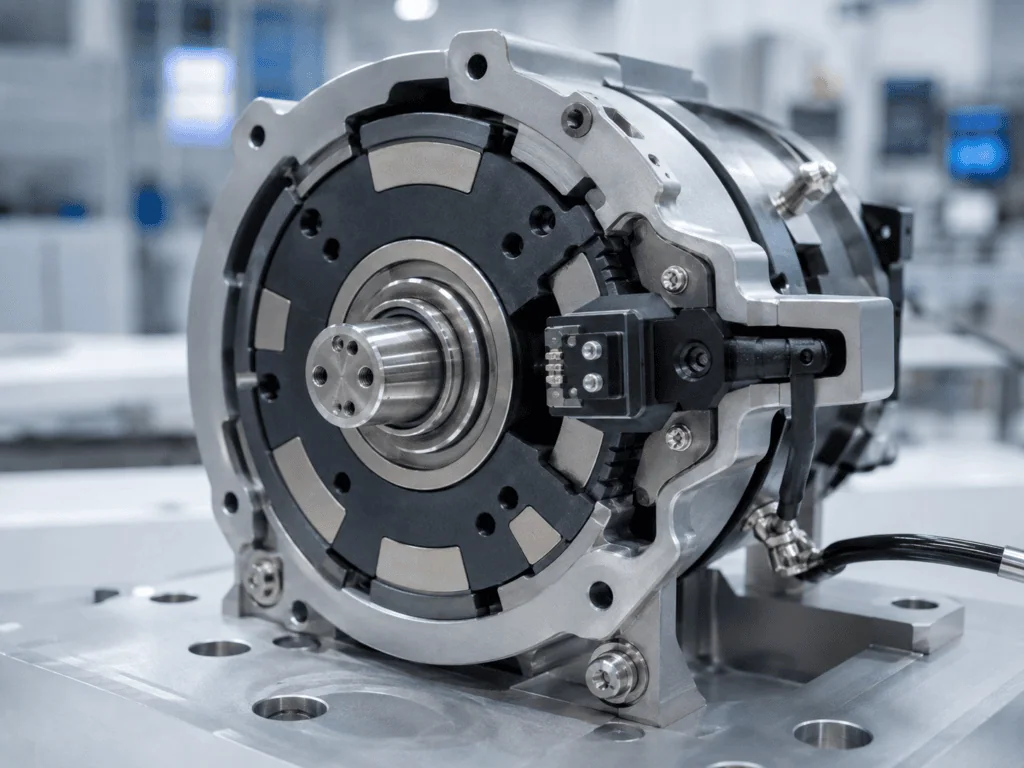
A machine builder specs a standard disc magnet for a rotary position sensor. On the bench, it performs exactly as expected. Then the assembly moves into a production machine, where a nearby drive adds electrical noise, the enclosure traps heat, and the sensor starts reporting drift under load. The magnet was not defective, but it was never designed for that machine.
This is where many engineering teams start evaluating custom magnetic components. Standard magnets are often the right choice, because they ship from stock, , and cost little to prototype with. However, a magnet often has to do one specific job inside one specific machine. At that point, catalog geometry and generic magnetization become the constraint that the rest of the design works around. Custom magnetic components remove that constraint by treating the magnet as a designed part rather than a purchased commodity.
The sections below cover when custom parts earn their cost, what performance you gain, what you trade away, and how to evaluate a supplier before committing to tooling.
When Standard Magnets Stop Being the Right Answer
Most teams do not set out to specify custom magnetic components, and instead arrive there after a series of workarounds. A few reliable signals suggest that the switch is already overdue.
- You are adding hardware to make the magnet fit. Spacers, shims, brackets, and adhesive fixtures each add another tolerance and another potential failure point.
- Field direction matters more than field strength. Sensing and motor applications usually depend on where the flux goes rather than on how much of it exists.
- Assembly labor keeps climbing. Placing and orienting loose magnets by hand is slow work, and it invites reversed-polarity errors once volume rises.
- The operating environment is degrading the part. Heat, coolant, washdown, vibration, and impact all shorten the life of a magnet pulled from a general-purpose catalog listing.
- You are oversizing for margin. Catalog sizes come in coarse steps, so teams often buy more magnet than the application needs and pay for it in space, mass, and unit cost.
Any one of these is manageable on its own. Together, they usually mean the design has outgrown standard parts.
What You Gain by Designing the Magnet Into the Machine
The value of custom magnetic components is rarely raw strength: it is control over where the field goes and how consistently it behaves.
- Predictable field behavior. Geometry, pole configuration, and magnetization direction determine where flux concentrates. A custom part can focus field across the working air gap and limit stray field elsewhere in the machine.
- Fewer parts in the stack. Magnetic assemblies combine the magnet with pole pieces, housings, and mounting features in one component. That consolidation shortens the tolerance stack and simplifies the bill of materials.
- Recovered space and mass. Right-sizing the magnet to the actual duty frees packaging volume, which matters in compact drives, portable equipment, and vehicle systems.
- Repeatability at volume. A dedicated part number with defined inspection criteria produces consistent unit-to-unit behavior, and calibration routines depend on exactly that.
- Room to optimize instead of compensate. When the magnet becomes a design variable, engineers can tune the magnetic circuit rather than adding software correction or mechanical adjustment later.
Application Priorities Differ by System
Custom magnetic solutions are not a single discipline, so what counts as an improvement depends on the machine and the conditions it runs in:
Industrial machinery design
Uptime and serviceability dominate here, because holding, clamping, separation, and conveying applications all see impact, abrasion, and contamination. Durability and mounting robustness therefore tend to outrank peak pull force. A custom holding assembly that survives years of shop-floor handling delivers more value than a stronger magnet that chips on the first drop.
Sensor applications
Consistency outranks strength in sensing work. Position, speed, and proximity sensing all depend on a stable, well-shaped field. That field has to behave the same way across every unit and across the temperature range the machine sees. Small variations in magnet geometry or magnetization will shift a sensor’s output curve. Tighter control of the magnetic source is therefore often the cheapest route to better sensing accuracy.
Automotive engineering
Environment and documentation carry roughly equal weight here. Temperature cycling, vibration, moisture, and long service life all narrow the material options. Program requirements then add expectations around process control, traceability, and change management. Automotive engineering teams generally need a supplier who can hold a process steady across years of production, not simply deliver an acceptable first article.
The Design Tradeoffs Worth Planning For
Custom magnetic components are not free, and treating them as free leads to schedule surprises later. Plan for the following realities early in the program.
- Tooling and setup cost. Custom geometry usually requires tooling or fixturing, and that cost amortizes over volume, so run the math on annual usage before committing.
- Longer first-article timelines. Expect more calendar time for initial parts than for a stock item, particularly when magnetization fixtures or assembly tooling are involved.
- Minimum order quantities. Custom production runs have economic batch sizes, so low-volume programs sometimes do better with a standard magnet inside a custom assembly.
- Design discipline. Once tooling exists, changes cost real money, so freeze the mechanical interface and the magnetic requirement first and treat later revisions as formal engineering changes.
- Validation ownership. A custom part arrives without field history, so your team defines the acceptance criteria and runs the qualification. Build that test time into the schedule.
- Narrower second-source options. A custom part is harder to dual-source than a catalog item, so discuss capacity, inventory programs, and contingency supply during the quote rather than after launch.
How to Evaluate a Supplier for Custom Magnetic Components
Most magnet suppliers can quote from a drawing, but far fewer can help you get the drawing right in the first place. When comparing sources for custom magnetic components, weigh these factors.
- Do they ask about the application first? A useful quote conversation covers air gap, duty cycle, operating environment, mounting method, and test criteria. A supplier who quotes only from dimensions is pricing a shape, not solving a problem.
- Can they build assemblies, not just magnets? Assemblies require fabrication, bonding, and magnetization capability under coordinated process control. Sourcing those steps separately moves integration risk onto your team.
- Are they production-ready? Ask how they plan to make prototype parts and whether that process matches production, because process changes between phases remain a common source of late surprises.
- Do they discuss material honestly? Neodymium, samarium cobalt, alnico, and ceramic materials each suit different conditions, and a supplier who recommends the same one every time is not evaluating your application.
- What documentation comes with the part? For OEM programs, inspection reports, magnetic test data, and change-notification practices matter as much as unit price.
- How do they respond when something changes? Programs shift, and the practical value of a magnetic partner shows up in how quickly they handle a revision, a rush build, or a supply question.
Custom magnetic components earn their place when the magnet stops being a purchased item and becomes part of how the machine performs. That shift usually happens earlier than teams expect, often at the moment someone adds a third bracket to make a catalog magnet work.
Adams Magnetic Products has supported industrial manufacturers and OEM engineering teams since 1950. We pair stock magnet supply with custom fabrication, magnetic assemblies, and engineering support. Our team starts with application requirements, including environment, air gap, duty cycle, and production volume, then recommends the material and configuration that fit the machine.
Working on a design that standard magnets are not serving well? Talk to an Adams engineer about your application, or send your drawing and requirements to request a quote. Call 800-747-7543 or email info@adamsmagnetic.com.
Related Posts