
What “Permanent” Actually Means Under Temperature
When a magnet is called “permanent,” it’s easy to assume that means its performance stays the same no matter what the application throws at it. In practice, that’s not what “permanent” guarantees.
A permanent magnet retains its magnetization without needing an external field or power source. What it does not guarantee is constant magnetic output across all temperatures. As temperature changes, key magnetic properties change with it, and those shifts can show up as lower holding force, reduced torque, weaker sensor response, or performance that drifts outside expectations.
For engineers, technical buyers, and product teams, that distinction matters. If a system works at room temperature but starts missing the mark in the field, temperature may be one of the first variables worth checking.
Where the Assumption Goes Wrong
In many applications, magnets are selected from a datasheet, approved in testing, and expected to behave the same way in service. That usually works well until real operating conditions begin to differ from lab conditions.
A common assumption is that a permanent magnet’s listed strength applies universally. But most magnetic properties are temperature-dependent. A magnet can still be “permanent” in the sense that it remains magnetized, while its actual performance changes meaningfully as the environment heats up or cools down.
A component may not have failed outright. It may simply be operating differently because the magnet is no longer delivering the same magnetic output it did at room temperature.
What Changes With Temperature
Two of the most important magnetic properties to watch are remanence and coercivity.
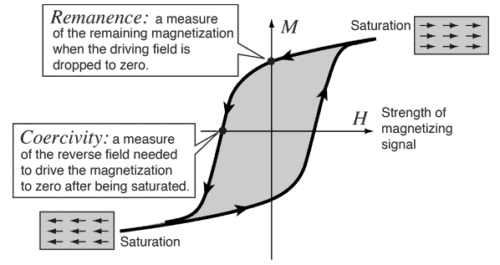
Remanence (Br) refers to the magnet’s residual flux density, or the level of magnetic output it retains after magnetization. As temperature increases, remanence generally decreases. In practical terms, that means the magnet may produce less field strength at elevated temperatures than it did under standard test conditions.
Coercivity (Hc or Hci) is the magnet’s resistance to demagnetization. This matters just as much, and often more, in real applications. As temperature rises, coercivity also changes, which can make the magnet more vulnerable to losing part of its magnetization if the magnetic circuit, opposing fields, or operating conditions push it too far.
These material properties directly affect how a magnetic component behaves in an assembly, motor, sensor system, closure, or holding application.
Reversible Loss vs. Irreversible Loss
One of the most important distinctions to understand is the difference between reversible and irreversible performance loss.
Reversible loss. As temperature rises, a magnet’s output typically drops. If the magnet remains within a safe operating range, that reduction is often reversible. Once the temperature returns to normal, the magnet’s performance returns as well. This kind of behavior can create intermittent or environment-dependent issues. A system may feel weaker during hotter operating cycles, then appear normal again later. That pattern can make troubleshooting difficult if temperature is not being considered.
Irreversible loss. Irreversible loss happens when temperature and operating conditions push the magnet beyond its coercivity limits. At that point, the magnet can become partially demagnetized and will not fully recover when the temperature drops. This is where the term “permanent” can be especially misleading. The magnet is still a permanent magnet, but part of its original strength is gone for good.
In some applications, this can be loosely understood through the magnet’s operating point on the BH curve. If temperature shifts the material properties enough, and the magnetic circuit is already operating near the edge, the magnet may cross into a region where permanent loss occurs.
Not All Permanent Magnet Materials Respond the Same Way
Temperature behavior varies by material, which is one reason material selection should be tied to actual operating conditions rather than room-temperature performance alone.
NdFeB (neodymium iron boron) magnets offer very high strength, which makes them attractive in compact, high-performance applications. But they are generally more temperature-sensitive than some alternatives unless the right grade is selected for the environment.
SmCo (samarium cobalt) magnets typically offer better thermal stability and stronger resistance to demagnetization at elevated temperatures. That makes them a strong option for harsher thermal conditions, though cost can be a factor.
Ferrite (ceramic) magnets have lower magnetic strength than rare earth materials, but they can function across wide temperature ranges and can be a solid fit where thermal reliability matters more than maximum field strength.
The right choice depends on the application. A stronger magnet is not always the better magnet if the operating environment pushes it outside its comfort zone.
Why This Matters in Real Applications
This issue shows up in the kinds of situations engineers and buyers deal with every day. A product may meet performance targets during benchtop validation, then underperform once it sees higher ambient temperatures, internal heat buildup, or repeated thermal cycling. A magnetic closure may lose holding force in warmer conditions. A motor application may deliver less torque than expected after temperature rises. A sensor-related assembly may show inconsistent behavior across environments, even though the original component spec looked acceptable.
A team may review incoming parts, compare them to the original requirements, and still struggle to explain why field performance is drifting. In many of these cases, temperature does not destroy the magnet outright. It changes the magnetic properties enough to affect the system. That’s why magnets should be evaluated in the context of the actual operating environment, rather than just nominal room-temperature values.
What to Watch for in Your Application
If magnetic performance drops at higher temperatures, temperature effects may be part of the explanation. A few practical reminders can help:
- Do not assume room-temperature datasheet values reflect real operating conditions
- Review the actual temperature range the component will experience, including short-term spikes and repeated cycles
- Consider whether reduced remanence at elevated temperature could affect holding force, torque, sensing, or stability
- Pay attention to coercivity, especially in applications where the magnet may face opposing fields or a challenging magnetic circuit
- Ask how the selected material and grade perform across the full operating environment, not just under standard conditions
- Flag temperature as a key variable when discussing unexplained performance changes with suppliers
Often, the problem is not that the magnet is “bad.” It may be that the material, grade, or operating margin does not match the thermal reality of the application.
A More Useful Way to Think About “Permanent”
Permanent magnets are essential because they retain magnetization without external power. That makes them incredibly useful across motors, sensors, closures, medical devices, electronics, and many other applications.
But “permanent” should be understood as a magnetic condition, not a promise of identical performance under every temperature. That distinction can help teams evaluate components more realistically and identify the cause of performance issues sooner. It can also reduce unnecessary rework by shifting the conversation from “why is this failing?” to “what conditions is this magnet actually seeing?”
Adams Magnetic Products works with customers to evaluate magnetic performance under real operating conditions, support material and grade selection, and troubleshoot when field behavior does not match expectations.
If your application involves temperature variation, it’s worth looking beyond room-temperature specs. Contact our engineering support team to review your operating conditions, or request a quote for your project.
Related Posts