
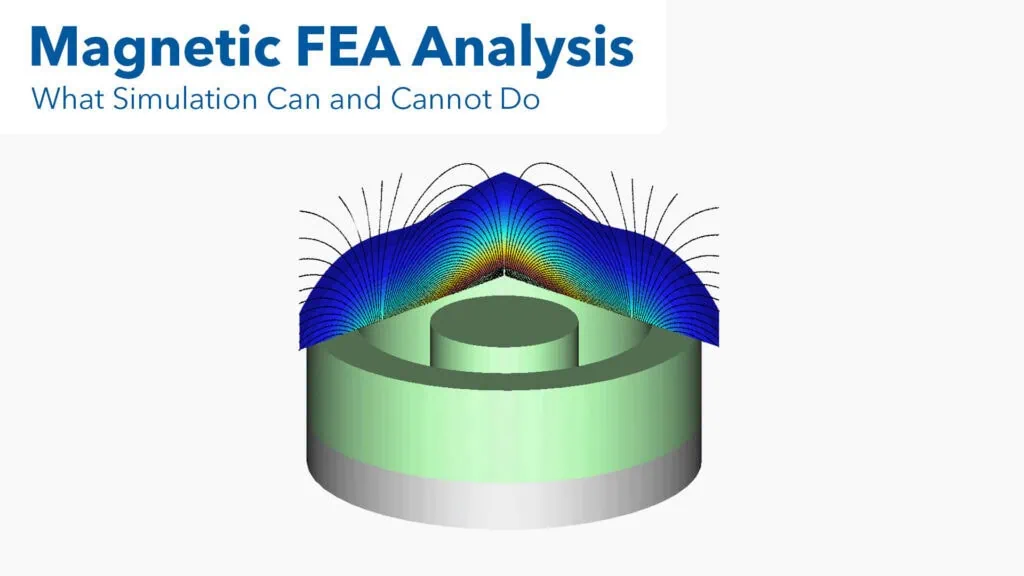
Magnetic FEA (Finite Element Analysis) analysis has a reputation problem in both directions. Some engineers treat a simulation result as a specification, and are surprised when the built part measures differently. Others dismiss it entirely because a colleague once modeled an assembly that did not match reality.
Both reactions come from the same misunderstanding about what finite element analysis of a magnetic circuit is for. It is not a substitute for building a part. It is a way to answer comparative questions quickly, before you build anything, and it is very good at that.
What magnetic FEA analysis is good at
Comparing options. The real strength of simulation is relative, not absolute. If you want to know whether adding a steel backing plate improves field at the working face more than stepping up a grade does, FEA answers that in an afternoon and the answer is reliable even when the absolute numbers carry some error. Both options are modeled with the same assumptions, so the comparison holds.
Showing where the flux goes. A field plot makes leakage visible in a way a measurement cannot. Seeing that a third of your flux is going into a mounting bracket explains a performance shortfall faster than any bench test, and it points directly at the fix.
Testing sensitivity. How much does performance change if the air gap grows by half a millimeter from tolerance stack-up? What happens at the low end of the material’s published property range instead of the middle? These questions are tedious to answer experimentally and quick to answer in a model. They are also the questions that separate a design that works from one that works most of the time.
Exploring geometry before committing to tooling. Pole piece shape, cup wall thickness, magnet aspect ratio. These are cheap to vary in a model and expensive to vary in hardware.
What it does not do on its own
It does not model what you did not tell it about. The most common reason a simulation disagrees with a measurement is that the real assembly is mounted to steel structure the model did not include. Magnetic circuits do not end at the part boundary.
It does not capture material variation. A model runs on one set of property values. Real magnets fall within a range, and the assembly has to work across that range. Modeling the nominal case and ignoring the low end produces an optimistic answer.
It does not predict manufacturability. A model has no opinion about whether the geometry can be assembled consistently, whether the magnet can be held during bonding, or whether the tolerance stack is achievable. Those constraints have to come from people who build the part.
It does not replace a measurement. The physical part is still the specification. Simulation reduces the number of physical iterations you need, which is where it pays for itself.
Four inputs that decide whether the result is useful
- Accurate material properties, including behavior at temperature. A model run with room-temperature properties tells you nothing about an assembly that operates hot.
- The complete circuit, including surrounding structure. Mounting plates, brackets, nearby steel components. If it is ferrous and it is close, it belongs in the model.
- Realistic geometry, including the air gap you will actually get. Model the tolerance extremes, not just nominal.
- A defined question. Simulation answers specific questions well and vague ones poorly. “Is this design good” produces a pretty picture. “Does this design deliver the required field at 5 millimeters with the magnet at the low end of its property range and the gap at maximum” produces a decision.
When simulation is worth the time, and when it is not
Magnetic FEA analysis earns its place when the geometry is unusual, when the design is close to a performance limit, when tooling costs make an iteration expensive, or when you need to understand a failure that a measurement alone cannot explain.
It is usually not worth it for a straightforward holding assembly in a well-understood configuration, where experience and a prototype get you there faster. A supplier who has built a few hundred variations of a construction often knows the answer without modeling it, and that experience is an underrated form of analysis.
The practical approach is to use simulation to narrow the field to one or two candidate constructions, then build and measure. Modeling everything is slow. Building everything is slower.
Optimization is a tradeoff exercise, not a maximization one
The word optimization suggests a single best answer. In assembly work there is almost never one, because the objectives compete. Maximum field at the working face, minimum package size, temperature margin, cost and manufacturability pull in different directions, and the design that maximizes any one of them is usually poor at the others.
The useful version of optimization is deciding which constraint is genuinely hard and then spending the remaining freedom on the others. That ranking is an engineering judgment about your application, which is why it works better as a conversation than as a solver setting.
Put the analysis behind a real part
Adams Magnetic Products applies magnetic analysis in support of assembly design, alongside the fabrication, assembly, magnetization and testing that follow it. The value of the analysis is that it shortens the path to a part that works, not that it produces a report.
If you have a design that is close to its limit, or a built assembly that is not behaving the way the model said it would, Talk to a Magnet Expert. Bring the geometry, the surrounding structure and the operating temperature, and we will tell you what we would look at first.
Related Posts