
Hall Effect Magnetic Sensors
Optimize Your Magnetic Sensor Performance with Adams’ Magnetic Expertise

Hall Effect Sensor Magnets
Optimizing Magnet-Sensor Integration for Reliable Performance
Hall effect magnetic sensors play a critical role in modern industrial systems and applications, converting magnetic field strength into precise electrical signals used to measure position, speed, and rotation. At Adams Magnetic Products, we design and supply the magnets that make those sensors work reliably – even in the most demanding environments.
From linear actuators to robotics, our Hall effect magnetic sensors deliver stable performance, repeatability, and durability over wide temperature ranges and across millions of cycles. Whether you’re designing a joystick, encoder, or safety interlock, Adams can help you specify the right magnet for your sensing system.
Their non-contact, wear-free design ensures consistent performance and minimal maintenance over a long service life – essentially, “set it and forget it.”
They come in a wide variety of shapes, sizes, and price points and can be as large as your fingernail or as small as a grain of sand.
Why Magnet Selection Matters
The magnet is the heart of any Hall effect sensing system. Its size, material, grade, and magnetization pattern all directly affect the sensor’s accuracy and stability. Choosing the right magnet can:
- Ensure the proper magnetic flux density at the sensing distance (air gap)
- Maintain consistent performance across temperature changes and vibration
- Reduce failure rates caused by demagnetization or misalignment
- Lower costs by optimizing material use and manufacturability
Different magnetic sensor materials offer unique advantages:
- Neodymium (NdFeB): High strength and compact size for space-constrained designs
- Samarium Cobalt (SmCo): Excellent temperature stability and corrosion resistance
- Alnico: Reliable at elevated temperatures with low coercivity for adjustable applications
- Ceramic/Ferrite: Cost-effective option for moderate-field requirements
Adams engineers help customers evaluate tradeoffs between performance, cost, and manufacturability to ensure the magnet meets both electrical and mechanical system goals.
Measurement

Position
To measure position, one uses a predefined magnet that moves towards/away from the magnetic sensor. The sensor detects the strength of the magnetic field and infers the location of the magnet from that data.
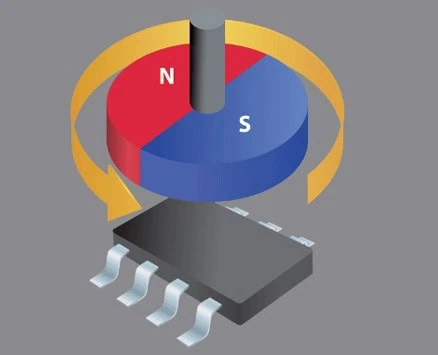
Rotational Position
To measure rotational position, an array of magnetic Hall effect sensors is used in conjunction with a diametrically oriented magnet. The magnetic field distribution in the array is used to calculate the rotational position of the magnet.
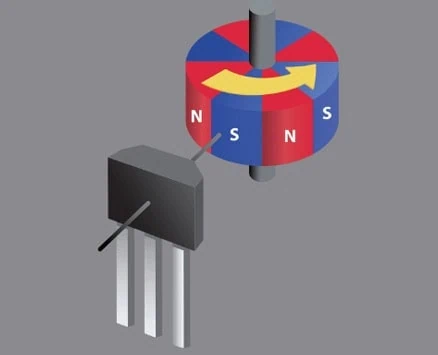
Velocity
To measure velocity, one can use the same array configuration used for rotational position.
Alternatively, one can position the magnetic sensor off-axis and measure the pulses as the object rotates.
Most Commonly Used Magnets for Hall Sensor Applications


Engineering Support for Hall Effect Applications
Adams Magnetic Products has decades of experience designing magnets for sensor systems. Our team works with you to solve common design and production challenges, such as:
| Technical Concern | Why It Matters | How Adams Helps |
|---|---|---|
| Magnetic Field Strength & Uniformity | Sensors require a defined field range for reliable switching or linear output. | We size and shape magnets to deliver the right flux density over your operating air gap. |
| Temperature Stability | Magnets can lose field strength as temperature rises. | We recommend materials and coatings that withstand extreme heat or cold. |
| Mechanical Alignment | Off-axis magnets or inconsistent gaps can distort magnetic sensor readings. | We design fixtures and magnet geometries that maintain alignment and minimize tolerance stack-ups. |
| Manufacturing Efficiency | Cost, yield, and availability matter for production scalability. | We offer cost-engineered materials, tight tolerance control, and a robust global supply. |
| Integration with Assemblies | Housing materials, mounting methods, and orientation all influence performance. | We collaborate on subassembly drawings and assembly processes to ensure optimal sensor function. |
More Applications Adams Supports
Our Hall effect magnetic sensors are also used in a wide range of industrial and OEM applications, including:
- Rotary and Linear Encoders: Precise position feedback for automation and robotics
- Industrial Joysticks and Controls: Position detection that won’t wear out in rugged environments
- Safety Interlocks: Door, lid, and guard monitoring in machinery and equipment
- Heavy Equipment and Off-Highway Vehicles: Reliable operation under vibration, dust, and temperature extremes
- Renewable Energy Systems: Rotor position sensing in wind turbines and generators
- Material Handling Systems: Conveyor speed and proximity sensing in logistics automation
Why Engineers and OEMs Choose Adams
- Expertise in Magnetic Design: Our engineers understand both the magnetic and mechanical aspects of Hall effect sensor integration.
- Custom Magnet Manufacturing: From prototype discs and rings to complex multi-pole magnetized assemblies, we provide precision parts tailored to your design.
- Quality and Consistency: ISO 9001-certified processes ensure every batch meets your field-strength and dimensional specifications.
- Speed and Supply-Chain Reliability: We shorten lead times and help customers maintain production continuity with dependable sourcing.
- Lifecycle Support: From concept to production, we assist with design validation, magnetizing fixtures, coating selection, and testing.

Partner with Adams Magnetic Products
No two Hall effect sensor applications are exactly alike – and neither are the magnets that drive them. Our application engineers are ready to help you:
- Optimize magnet geometry for your specific sensor and air gap.
- Select the ideal magnetic material and grade for your environment.
- Prototype and validate performance before scaling to production.
- Improve cost and consistency across your global supply chain.
Let’s make your sensing system stronger, smarter, and more reliable.
Contact our engineering team to start your Hall effect magnetic sensor project today.
Interested in Learning More?
Adams is ready to be a part of your products with off-the-shelf and custom applications. Contact us to find out more.