
Magnetic Components Engineering: Experience That Counts
Our engineering team has successfully designed thousands of custom magnet assembly solutions, including those for the rovers on Mars and several lifesaving medical products.
Overview
Adams Magnetic Products has the capabilities to build complex custom magnet assemblies, ensuring reliability and precision for technical and mission-critical applications. Our magnet company’s custom-engineered magnets, consultative approach, innovative mindset, inventory levels, and commitment to cost and speed make us a versatile partner. Count on us to provide:
- Magnetic components engineering
- Quick-turn prototyping
- Magnetic characterization
- System integration
Located in Chicago, we reliably fabricate custom assemblies in various volumes and materials, providing engineering support and sourcing necessary components. ISO 9001:2015 certified and ITAR registered, Adams meets even the most stringent quality standards.
Why Choose Adams?
In addition to thousands of in-stock standard shapes and sizes, Adams Magnetic offers:
- Competitive pricing of components and services
- Application and engineering support
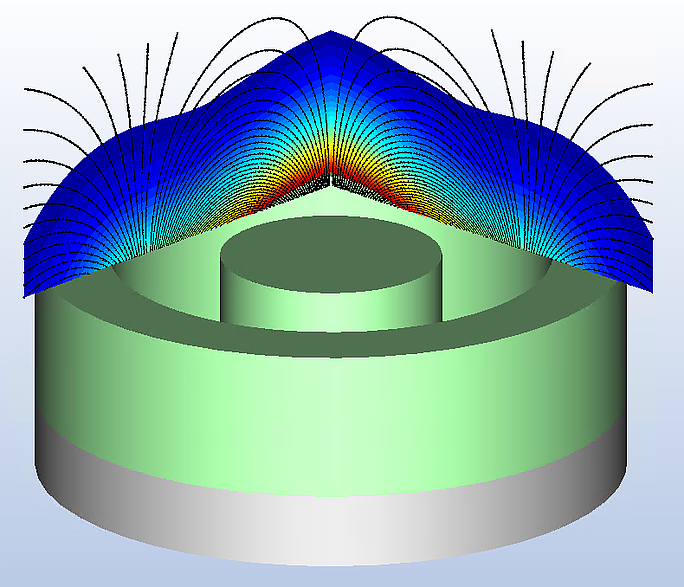
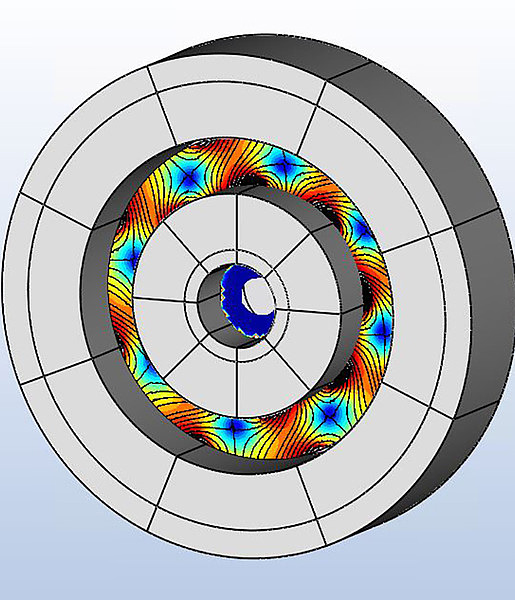
- Magnetic circuit analysis/FEA
- Design review and verification
- Material testing, validation, and certification
- Only licensed materials
- Quick-turn samples and short-run production
Our Magnetic Components Engineering
At Adams, we fabricate, assemble, and distribute devices that use magnetic fields to perform specific functions in electrical and electronic systems. We do everything from design and simulation to selecting the best materials for your project and testing and quality control for your specialized applications.
Industries we serve include:


No Challenge Too Great
Adams has the knowledge, expertise, and procedures to meet even the most stringent quality standards. Give us your challenge, and we’ll meet it with over 75 years of experience and ingenuity. Only providing the best magnetic materials and assemblies, we apply creativity, robust operations, and technology to meet the requirements of your project while being extremely cost-efficient. Adams is an ISO 9001:2015 certified and ITAR-registered company. Adams is ready to be a part of your products with off-the-shelf and custom applications.
Interested in Learning More?
Adams is ready to be a part of your products with off-the-shelf and custom applications. Contact us to find out more.
What's Next?
A customer service representative will get back to you shortly. Depending on your requirements, a member of our engineering or business development team may follow up with you.
Frequently Asked Questions
What are complex custom magnet assemblies?
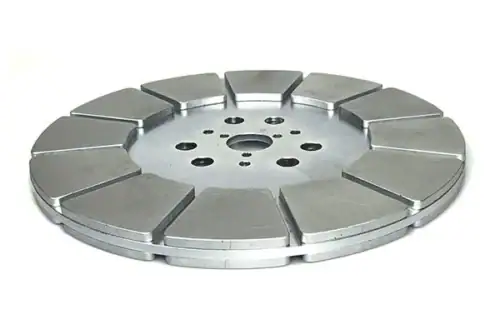
Complex magnetic assemblies achieve specific magnetic functionalities that a standalone magnet can’t. These engineered systems integrate permanent magnets with other components such as supporting structures of metal housings. These custom magnet assemblies increase magnetic strength, protect fragile magnets, and allow for mounting or integration into a plethora of other devices.
What is a permanent magnet assembly?
A permanent magnet assembly combines one or more permanent magnets with other components. The other components can be magnetic or non-magnetic; together they create a unified system of specific functionality. These assemblies can be used in electric motors, generators, medical devices, loudspeakers, and industrial applications. Common types of permanent magnets used in these assemblies include ferrite, and alnico magnets.
Can I talk to an engineer about my application?
Yes. Adams works with customers to review magnetic applications and determine the right material, configuration, and assembly approach. Our team can help evaluate requirements such as pull force, field strength, operating temperature, environmental exposure, mounting method, size constraints, tolerances, and how the magnet or assembly will function in the final product.
Involving Adams early in the design process can help identify performance, manufacturability, cost, and supply chain considerations before the design is finalized.
What magnetic engineering services does Adams offer?
Adams offers magnetic engineering and application support for customers developing custom magnets and magnetic assemblies. Services may include application review, material and grade selection, magnetic circuit analysis, finite element analysis when appropriate, prototyping support, testing, validation, and design-for-manufacturability guidance.
Our team can help customers evaluate magnetic performance, operating conditions, dimensional requirements, mounting methods, coatings, and assembly options to develop a solution that is practical, reliable, and suited to the intended application.